Football Boots for a High Instep: Why They Pinch on Top and What Helps
Your boots fit in length and even in width, yet the top of your foot aches once the laces are tight. That is usually a high instep, and it is a different problem from wide feet. Here is how to tell which one you have, what you can try first, and when custom boots make sense.
Width and instep are two different problems
Width is the distance across the ball of your foot. Instep is the height of the top of your foot, between the toes and the ankle. A boot can be wide enough and still too low on top, so going for a wider model does not always help. Many modern boots are built low and tight over the top of the foot for ball feel, which is exactly where a high instep presses.
Signs your instep is the problem
- Pressure or numbness on the top of your foot, under the laces, not on the sides
- You can barely tie the laces, or the two sides of the lacing almost touch the tongue edge
- The pain eases when you loosen the laces, but then your heel slips
- Getting your foot into the boot is a struggle even though the length is right
Try first: lace around the high point
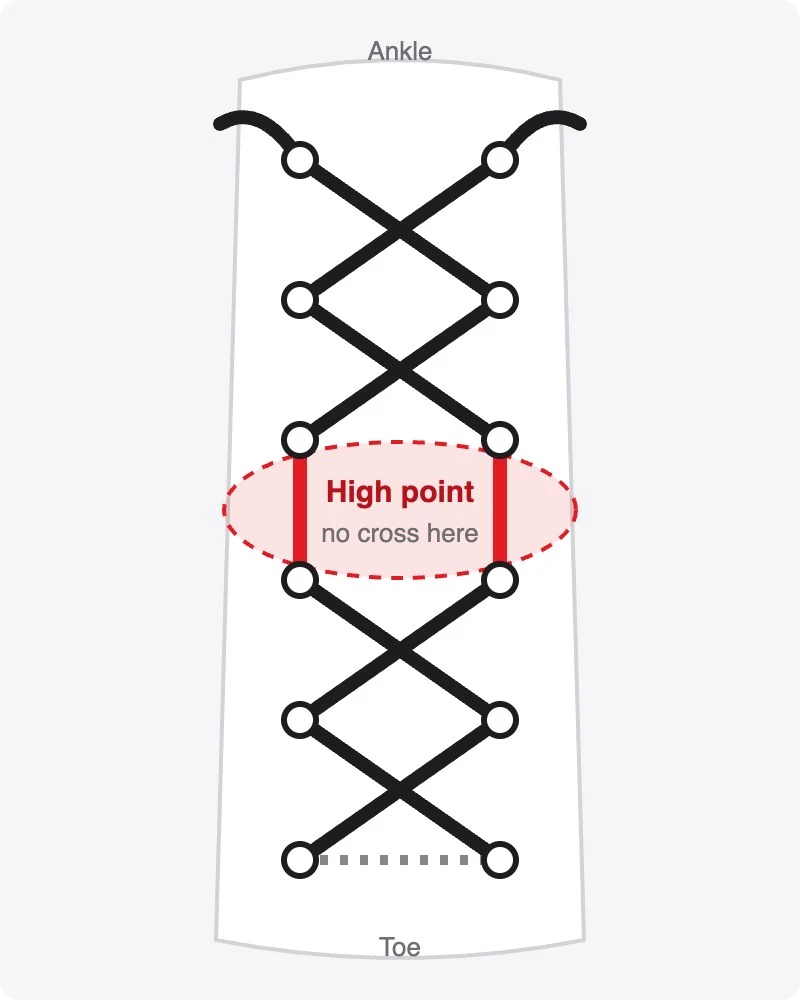
Find the eyelets right over the highest part of your foot. Cross the laces as usual up to the pair just below that point. There, instead of crossing, run each end straight up on the outside into the next eyelet on the same side, then start crossing again above it. This leaves a gap over the pressure point while the eyelets below and above still hold the foot. Keep the top eyelets firm. Loosening everything to make room is the most common mistake, because your heel starts to lift and rub on sharp turns.
Choose an upper that can give
Soft leather, especially kangaroo leather, molds to the top of the foot after a few sessions. Knit uppers also stretch over a high instep from the first wear. Thin, stiff synthetic uppers built for speed give the least. Going up a full size for instep room rarely works: the length grows, but the heel and the toe box no longer fit.
When custom boots make sense
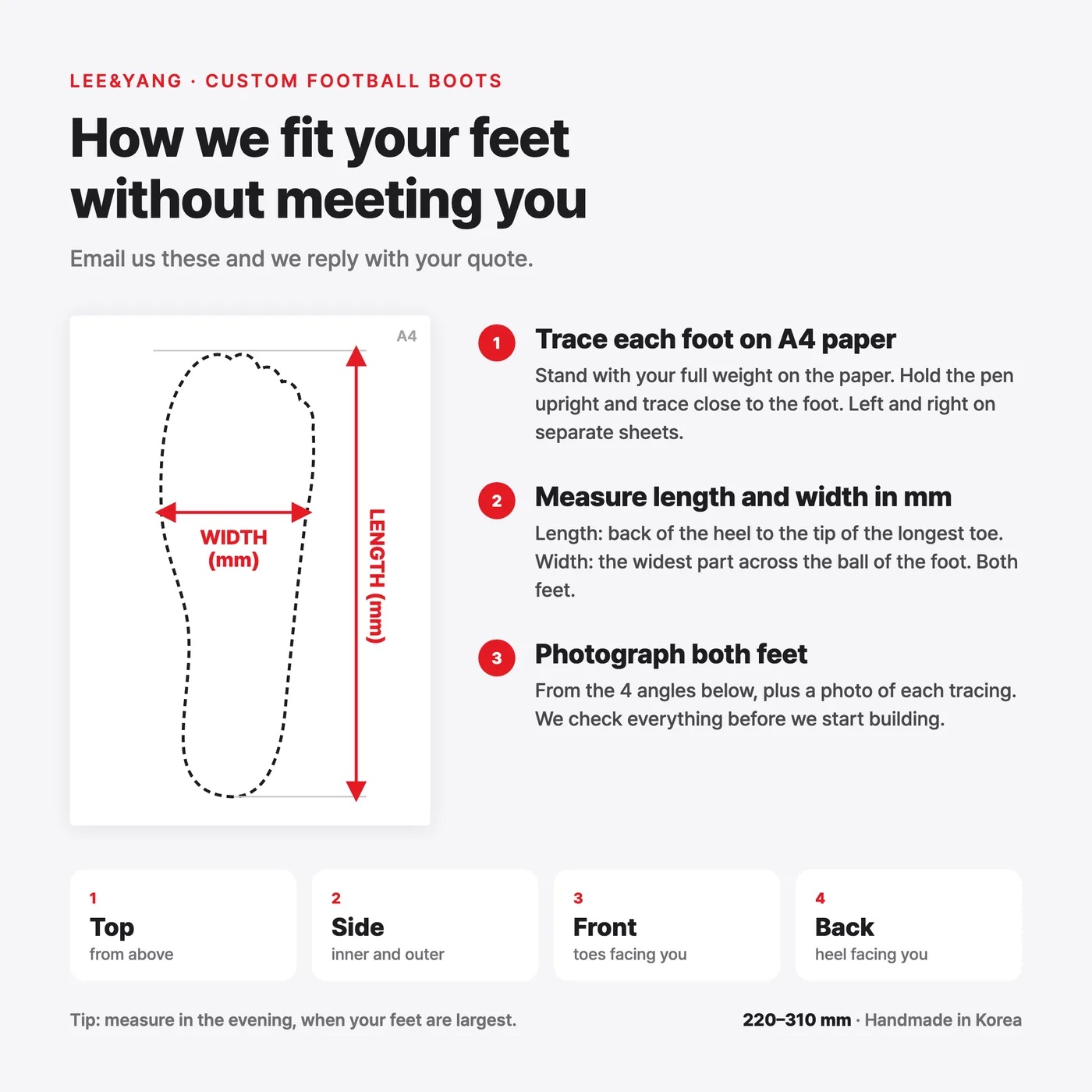
If lacing and a softer upper are not enough, or you also have wide feet or two different sizes, the fix is a last built for your feet. For custom boots we measure the length, width and instep of each foot and build the pair by hand in Goyang, Korea, in sizes from 220 to 310 mm.
You do not need to visit. From abroad you send:
- Foot length and width in millimeters, left and right
- Your foot outline traced on A4 paper
- Photos of both feet from the top, side, front and back. The side photos show us your instep height
Take the side photos standing, with your full weight on the foot. If we need more detail about your instep, we ask by email before you pay.
Which fix fits your feet?
- Mild pressure on top only: lace around the high point
- Pressure every game, normal width: a soft leather or knit boot in your true length
- High instep with wide feet, bunions or different-size feet: custom boots
Laces always too tight on top?
Send us your measurements and side photos of both feet. We will tell you honestly whether custom boots are worth it for you.
Ask on WhatsApp Custom boots