Resole or Replace? How to Tell When Your Football Boots Are Really Finished
The studs no longer bite when you turn. The sole is lifting at the toe. Your heel feels the ground through a sole that used to feel springy. The usual answer is a new pair. But if the part that is failing is the sole and not the upper, you may be able to keep the boots you already trust.
Judge the boot by its parts, not its age
There is no fixed lifespan for football boots. How often you play, the surface you play on and how you dry and store them all change how fast a pair wears. Two players can buy the same model on the same day and need very different things a year later.
A more useful question is which part is wearing out. A football boot is two main parts joined together:
- The upper: the leather or synthetic part that wraps your foot. This is what decides how the boot fits and feels on the ball.
- The sole unit: the outsole with the studs, plus the midsole layer between the outsole and the upper. This is what decides grip and cushioning.
The sole unit can be replaced. The upper, in practice, cannot. So the decision comes down to one thing: is the upper still good?
Sole problems are usually fixable
These are the signs that send most players to the shop, and all of them sit in the sole unit:
- Worn or rounded studs. You slip on quick stops and push-offs, especially on firm ground.
- A broken stud. On most modern boots the studs are molded into the plate, so one stud cannot be swapped on its own, but the whole plate can.
- The sole peeling away at the toe or along the sides. Caught early, it can often be re-bonded and reinforced.
- A cracked soleplate. The plate is finished, but the upper above it may not be.
- The wrong sole for where you play now. You moved from grass to artificial turf, or from outdoor pitches to futsal courts.
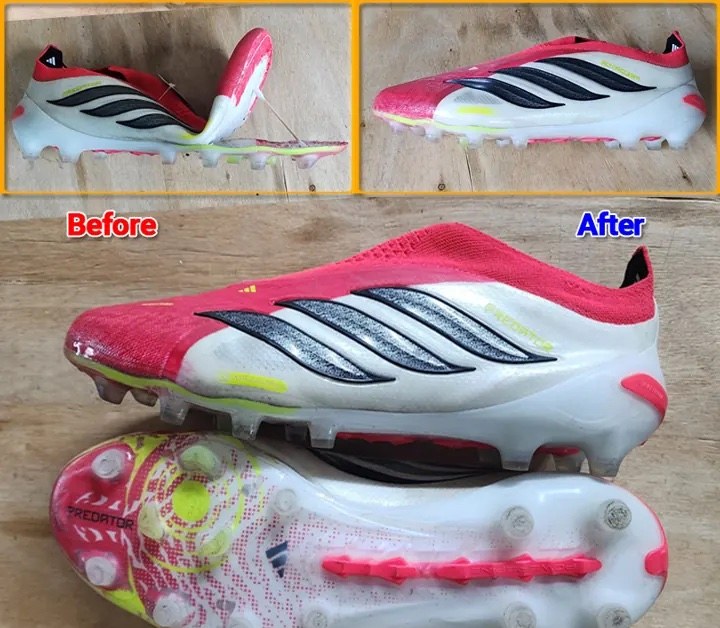
The photo at the top shows one of these. The sole had come away from the toe of an Adidas Predator. We bonded it back and added a clear reinforcing layer. The upper was fine, so there was no reason to retire the pair.
When the plate is worn or cracked, we remove the whole outsole and attach a new one. For broken studs and badly worn plates, our resoling guide explains the process step by step.
Upper problems: when a new pair makes more sense
A new sole cannot save an upper that has given up. We usually recommend buying new boots when:
- The upper is torn through in a place that affects the fit, not just a scuff on the surface.
- The leather or synthetic has dried out and is crumbling, cracking in many places or coming apart in your hands.
- The boots are very old and the surface coating is breaking down. Restoring it adds extra work on top of the resole, and the total can get close to the price of a new pair. In that case, compare before you decide.
Small problems on the upper are a different story. Worn lining, a toe that has scuffed through from dragging the ball, or a seam that has opened can often be patched or stitched as part of the same repair. Send photos and ask.
A quick checklist
Resoling is usually worth it when most of these are true:
- The upper has no tears that go all the way through
- The boots still fit you well, or fit after a small adjustment
- They are leather boots that have molded to your feet over time
- The model is discontinued, or you have not found a newer one that feels the same
- The problem is grip, cushioning or a sole that is coming loose
If the upper is the problem, or the boots never fit you well in the first place, a new pair is the better choice. If they fit badly because your feet need more room than any shop boot gives, custom boots are another option.
What a resole keeps, and what it can change
The upper stays the same, so the fit you are used to stays too. What changes is everything underneath.
- The midsole. The original midsole in most boots is a thin fabric layer that does not bond well to a new sole, so we replace it in almost every resole.
- The sole type. You pick from 19 numbered soles, so you can switch at the same time: FG to AG for artificial grass, MG to turf, or a futsal sole on boots you no longer wear on grass. The full list with photos is in our replacement sole catalog.
- Stiffness. Some boots get their firmness from a stiff soleplate. When that plate comes off, the boot can feel softer, so we may recommend reinforcing the midsole. We will tell you when the boots arrive.
- Size, a little. Because the upper is lifted out of the sole, we can lengthen or widen it slightly during a resole, usually by around 5 mm. We confirm the exact range after seeing the boots. This is only possible together with a resole, not on its own.
Getting a quote
Prices depend on your boots and the work they need. Send photos on WhatsApp and we will reply with a quote, usually within 2 to 4 hours. Include a side view of each boot, the bottom of the sole, and a close look at any damage on the upper. If the boots are not worth repairing, we will say so. This guide shows which photos help most.
The work usually takes 2 to 3 weeks, up to a month in busy periods. Our workshop is in Goyang, next to Seoul. You can visit by appointment, open daily from 10:00 to 19:00, or send the boots by courier within Korea. We will send you the Korean address on WhatsApp. You can also reach us on KakaoTalk (ID 21apro) or by email at 21apro@naver.com.
Not sure if your boots are worth saving?
Send a side view and the sole. We will tell you whether to resole them or buy new.
Ask on WhatsApp See 19 solesWatch the work
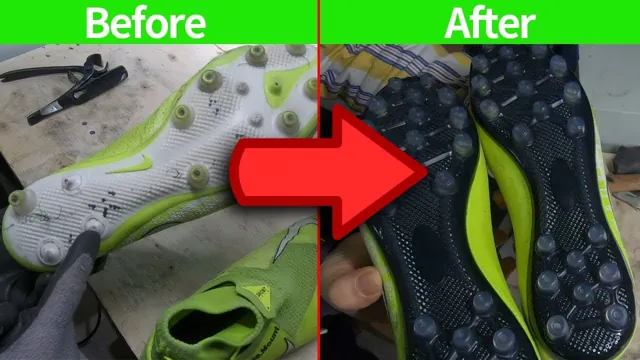
We take the worn sole off a Nike Phantom Vision AG and fit a new one. About 11 minutes. Watch on YouTube