FG Boots on Artificial Turf: What Happens and How to Switch to an AG Sole
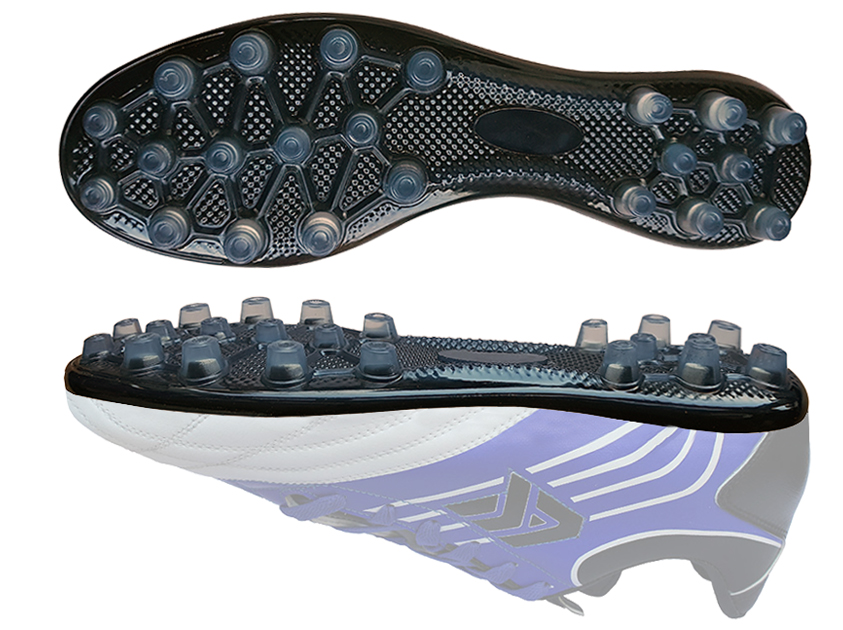
Most players own one pair of boots, and most of those boots say FG on the box. Then the weekly game moves to an artificial pitch, and the same pair goes with it. Many players do this for years without trouble. Others notice their studs wearing down fast, the toe of the sole starting to lift, or a sore forefoot after games. Here is why that happens, how to check your own boots, and how to switch the sole to one made for turf without giving up the upper you like.
Why FG and artificial grass do not always get along
FG stands for firm ground. An FG soleplate is designed for natural grass that is short and dry, or slightly damp. The studs are relatively long and few, so each one can push into the soil and give you grip when you turn and push off.
Artificial grass behaves differently. A modern 3G or 4G pitch is a carpet of synthetic fibres with rubber or sand infill. It is usually firmer than natural grass and more abrasive. Long studs cannot sink in the same way, so your weight rests on fewer, smaller points. At the same time, the infill can hold a stud when you twist, instead of letting it release.
Advice on this is not unanimous. Some brand guides describe firm ground plates as suitable for most artificial turf, while many retailers and experienced players recommend a dedicated AG sole for regular turf play. The honest answer is that it depends on the pitch, how often you play on it, and the boot. What is clear is the kind of wear to look out for.
Signs your FG boots are struggling on turf
These are the patterns players most often report when FG boots are used mainly on artificial grass:
- Studs wearing down unevenly, usually fastest under the ball of the foot and the big toe, where you push off.
- The sole lifting at the toe or along the sides, where the plate meets the upper.
- Cracks in the soleplate, often between the front studs, where the plate flexes the most.
- Pressure points under the foot, a feeling that you can sense each stud through the sole after a game.
- A grippy, sticky feel on turns, as if the boot wants to stay where it is while your body keeps moving.
If you see one or two of these early, the boots are not finished. In most cases the upper is still fine, and the problem sits entirely in the sole. That is the part we can replace.
AG and MG: the soles built for turf
An AG (artificial grass) sole uses many short studs spread across the plate. The load is shared between more points, which gives a stable feel on firm synthetic surfaces and helps the studs release when you pivot. An MG (multi-ground) sole sits in between: more studs than FG and a little shorter, for players who switch between turf and dirt pitches.
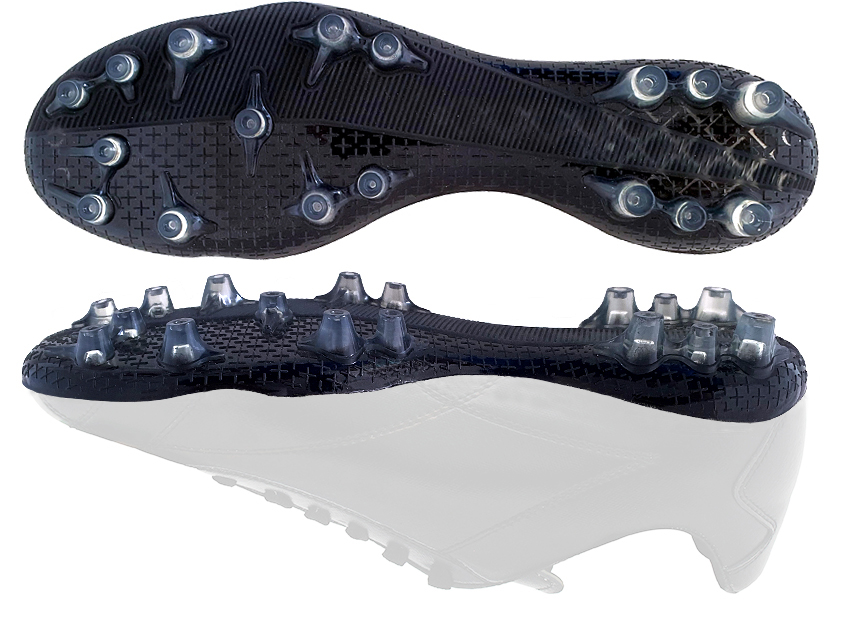
These are the turf soles in our catalog of 19 replacement soles:
- STUD-12 AG Artificial Turf: many short studs for a stable feel, black plate with clear studs, sizes 220 to 290 mm
- STUD-15 AG Tiempo-style: the same idea in a Tiempo-style stud layout, sizes 230 to 290 mm
- STUD-14 MG Multi-ground: for artificial turf and dirt, studs about 5 mm shorter than FG, sizes 235 to 290 mm
- STUD-14-1 MG Translucent: the same MG sole with a translucent plate and studs, sizes 235 to 290 mm
- STUD-04 Kids AG: natural rubber, tough and slow-wearing, for kids' sizes 165 to 215 mm
If your games are on short carpet-style turf or futsal courts rather than full-size 3G pitches, a turf or futsal sole may suit you better. Our guide to futsal shoes and football boots explains the difference.
Switching the sole instead of buying new boots
Buying a second pair of AG boots is one option. If you already have FG boots that fit you well, especially leather boots that have molded to your feet or a model that is no longer made, resoling is another. We take off the FG plate and attach an AG or MG sole of your choice to the same upper.
- The upper stays. The fit and touch you are used to do not change.
- The midsole is usually replaced too. The original midsole in most boots is a thin layer that does not bond well to a new sole, so we replace it in almost every resole.
- Stiffness may change. Some boots get their firmness from the original plate. If the boot feels softer without it, we may suggest reinforcing the midsole. We will tell you when we see the boots.
- A small size change is possible. Because the upper is lifted out of the sole, we can lengthen or widen it slightly at the same time, usually around 5 mm. This is only possible together with a resole.
If the upper itself is torn through or the material is breaking down, a new sole will not save it. Our post on whether to resole or replace your boots has a short checklist.
Getting a quote
Prices depend on your boots and the work they need. Send photos on WhatsApp with the sole number you are interested in, and we will reply with a quote, usually within 2 to 4 hours. A side view of each boot and a clear photo of the bottom of the sole help most. If you are not sure whether AG or MG fits your pitches better, tell us where you play and we will suggest one.
The work usually takes 2 to 3 weeks, up to a month in busy periods. Our workshop is in Goyang, next to Seoul, open daily from 10:00 to 19:00. You can visit by appointment, send the boots by courier within Korea, or post them from abroad (you pay shipping both ways). We will send you the address on WhatsApp. You can also reach us on KakaoTalk (ID 21apro) or by email at 21apro@naver.com.
Playing on turf in FG boots?
Send a side view and the sole. We will tell you whether an AG or MG sole makes sense for your pair.
Ask on WhatsApp See 19 soles